
Results of September 2026 Poetry Competition
The judge of our quarterly poetry competition is Dorothy Pope, the Society’s Poet in Residence, who also sets the theme for each competition.
Judge’s Report on the September 2026 Poetry Competition themed ‘Bird(s)’
The theme was variously interpreted as individual species, co-mourners, victims of guns, probers of shellfish and, as in the winning poem, ideas. Most were in free verse though there were a few sonnets and the one pantoum. The winner is ‘Fowl of Fate’ by John Keane. The runner-up is ‘The Uninvited Guest’ by Sally Steele.
‘Fowl of Fate’ is an extended metaphor with many birds for the many ideas the poet says he had for careers instead of having one definite plan — his raven, which would have earnt him a living. He looks back and regrets unfocused thoughts which have left him with no career and short of money. The poem is a sonnet, neither fully Shakespearean nor Petrarchan. Also, the iambic rhythm could so easily have been perfect with the removal of ‘truly’ from line 1 and ‘were’ from line 5. ‘Main’ is archaic and speaks of reaching for rhyme rather than being the best choice of words. However, this poem remains my favourite for originality of expression of the human theme of regretting what might have been.
The Uninvited Guest describes an ungrateful magpie which steals and stains and knocks over treasured ornaments of the one who feeds it. This form is not easy to write. In line 12, ‘in spite of’ should, I think, replace ‘despite’ to keep the iambic rhythm. Apart from this, it is a perfectly executed pantoum.
It was an interesting pleasure and privilege to read all of the poems submitted. Please note, however, that because of the sheer volume of work, I am unable to provide feedback other than on the two winners.
Dorothy Pope
The next poetry competition, themed ‘Garment(s)’ will be announced on 1 December 2026 on the Society’s website kingsenglishsociety.org and social media.
Fowl of Fate winner
Too many years ago, not knowing truly why
I sent untethered doves across the main.
A willing dozen, brightening the sky;
but none returned, in forms that I could name.
A futile exercise. All were surely lost
to hawks, to storms, calamities of fate.
Now none remain. Bereft, I count the cost
in squandered years and compromised estate.
I might have sent a raven, only one,
with wily eyes and wings of blackened steel
to ride the storms, and do what must be done
to spy the true, or truest road ahead.
Now ruin waits. A fate beyond appeal
to mock the errors of the heart unfed.
John Keane
The Uninvited Guest runner-up
The dinner-suited oast house guest
Stole from the kindly hands that fed,
Put thinning patience to the test,
Black spattered droppings stained the bed.
Stole from the kindly hands that fed,
Bruised pears and peaches marred the bowl,
Black spattered droppings stained the bed,
No luscious piece of fruit left whole.
Bruised pears and peaches marred the bowl,
Scattered shiny bedside treasures,
No luscious piece of fruit left whole,
Despite endless half-baked measures.
Scattered shiny bedside treasures,
Grown bolder daily by loose rein,
Despite endless half-baked measures,
With his pied and feathered brain.
Grown bolder daily by loose rein,
Put thinning patience to the test,
With his pied and feathered brain,
The dinner-suited oast house guest.
Sally Steele
Results of Aphorisms Competition
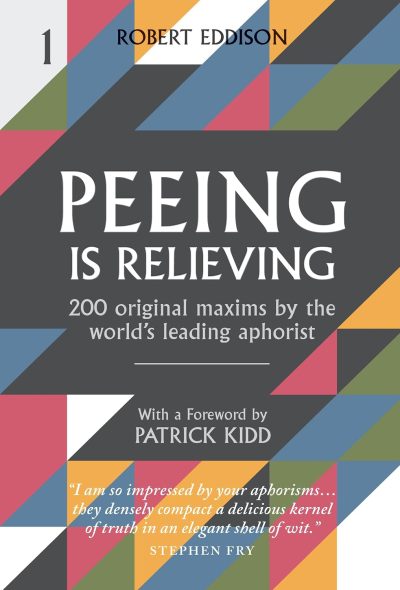
The judge of our aphorisms competition is aphorism writer Robert Eddison who notes that “Wordplay, like any game, should be taken seriously.”
Judge’s Report on the September 2026 Aphorisms Competition
It was a pleasure to serve as judge of the King’s English Society’s inaugural Aphorisms Competition. The entries were varied, carefully considered and well written. My criteria for the judging were concision, wit, elegance and originality. The winning aphorism displayed these characteristics and I was also impressed by its wisdom. The aphorism in second place used delightful wordplay in an original and truthful way.
The winning aphorism, by Jed Howling, is “Life might be unliveable were it not for our capacity to make molehills out of mountains.”
The runner-up prize goes to this aphorism by Bernard Lamb: “Finding the best ice cream is a terrific scoop.”
Well done to all the entrants for their effort and creativity and do please enter next year’s competition.
Robert Eddison
Results of June 2026 Poetry Competition
The judge of our quarterly poetry competition is Dorothy Pope, the Society’s Poet in Residence, who also sets the theme for each competition.
Judge’s Report on the June 2026 Poetry Competition themed ‘Statue(s)’
The theme of Statue(s) was variously interpreted as a snowman, a man keeping perfectly still or children doing so in the game of statues, stone, clay and wooden statues, statues hated, destroyed, cherished, prayed to, and Ozymandias which featured twice.
A disappointing entry in terms of quality this time. There were just two which were clearly better than the rest. Praise therefore goes to ‘Passer’ by Terry Jones and ‘Company’ by Sebastian Marziano.
In ‘Passer’, ‘Statue’ is interpreted as self standing still so as not to disturb a house sparrow (Passer domesticus) while it drinks and bathes at his birdbath. I question the American spelling of ‘grey’. Also, the slang phrase “come clean” jars with me and diminishes the poem’s grandeur. I liked “baptismal”, especially as it was preceded by “ritual” and “prayerful”. The poem finds an echo in every reader’s experience, I imagine.
‘Company’ by Sebastian Marziano would have been an English sonnet had line 6 not lacked an iamb. Why? I particularly liked lines 3 and 11 and 12. I saw the snowman, rebuilt annually, not just as a companion but also proof of man’s repeated trying again after setbacks.
Please note that because of the sheer volume of work, I am unable to provide feedback other than on the two winners.
Dorothy Pope
***************
Passer winner
That sparrow who visits the bird-bath —
however irregular his intervals,
his methods have a ritual consistency:
a prayerful bow into the stone bowl,
replenished more by us than by the rain;
watch his quick swigs and the baptismal finish;
he is, between sips, his own security
detail, eyes everywhere, till with no tell
he is gone, flicked away; but let me
come clean. It may not be the same bird
each time, but his doppelgangers
who fail to spot me, as I pause myself,
assume a gesture of permanence, hold it
in a stone figure, lined, weathered and gray.
Terry Jones
*************
Company runner-up
I built him from the weather I was in,
I rolled the heavy cold that wouldn't melt,
and pressed the whole white silence into skin,
a man the size of everything I'd felt.
I wound my own scarf twice around his throat
and turned him to the window square,
then buttoned him inside my outgrown coat
and went back in to lamplight, fire, and chair.
It wasn't spring that took him in the end.
The mild days came. The hard ground gave. He sagged
and all I'd built to stand for me now thinned
to sodden wool, spent coal, a heap of rag.
And still, each year, the cold comes back around,
my hands begin to build him from the ground.
Sebastian Marziano
*********************
The next poetry competition will be announced here and on the Society's social media platforms on 1 September 2026.
Photo: Marianna Smiley
Results of March 2026 Poetry Competition
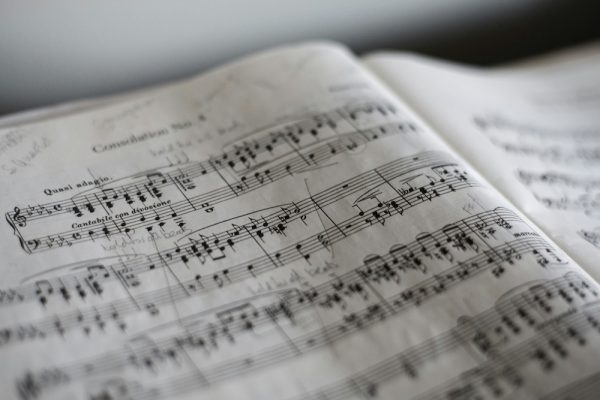
The judge of our quarterly poetry competition is Dorothy Pope, the Society’s Poet in Residence, who also sets the theme for each competition.
Judge’s Report on the March 2026 Poetry Competition themed ‘Music’
Poems on the theme of ‘Music’ featured dawn, orchestras, composing, church music, and church music after bombing, all in either free verse or as sonnets. Both first and second prize winners wrote about dawn though with different attitudes to the coming of the new day.
The winner is Gwyneth Box with her wonderful free verse poem ‘4 am: overture’. We hear with her the fidgeting, squeaking, crooning: tiny sounds of birds and animals as they stir. I particularly admired ‘a cockerel coughs his cliched script’. The verbs are a delight. ‘In the wings’ is clever, the title perfect. The poem’s ending of ‘A new day eases slowly into action’ serves to imagine the poet slowly easing herself out of sleep.
The runner-up is John Keane with his sonnet ‘Strange Notes’. This too is about the arrival of a new day but the poet sees it as unwelcome, an invader of sleep and dreaming, as ‘time lifts its iron head’ and the day’s demands. The final line is reminiscent of Keats’s conclusion to ‘Ode to a Nightingale’: ‘Fled is that music’.
Both poems were a joy to encounter.
Please note that because of the sheer volume of work, I am unable to provide feedback other than on the two winners.
Dorothy Pope
***************
The Winner
4 am: overture
Small birds fidget in the dark.
They squeak and whirr, then
birdsong swells and weaves
around the house in waves
of sibilance to spin a spell
that teases out the softening grey.
In the wings, a cockerel
coughs his clichéd script;
the neighbour’s cat croons
throatily and a distant dog
worries his concerns. The stage
is set. A new day eases slowly
into action.
Gwyneth Box
***************
The Runner-Up
Strange Notes
And music rolled like breakers to the shore
untarnished as a flake of minted snow:
more lucent than a darting spring in flow,
a flight of shining notes beyond all flaw.
Ere ray of morning light proclaimed the day
that fugue invoked a world of ecstasy,
supernal in its boundless mystery:
a place where time and trouble held no sway.
A motor turns, invading walls of calm
with urgent coughs. Time lifts its iron head.
The notes fall strange, and lose their elfin charm.
A sleepless chip brings pixels to a screen:
a message pings, demanding to be read.
And gone for good the music of a dream.
John Keane
***************
Photo: Marius Masalar